Qriton API
Software increasingly decides and remembers on people's behalf: what a model says, where things are, which record raised an alarm, what a monitor saw. The Qriton APIs keep those memories and decisions as explicit records, change them only on evidence, and provide receipt chains and outcome histories according to each service’s contract.
An independent record of what an AI system was told, changed and decided
When the output of an AI system is questioned, by a customer, an auditor or a regulator, the organisation has to show three things: what the system was told, what changed, and what it decided. The Qriton APIs keep that record as receipts, each linked by its hash to the one before, in a published format. Whoever holds the latest receipt can check, with the open verifiers on their own machine, that nothing was removed, added or edited since: without trusting Qriton, and without trusting the maker of the model.
What it was told
The facts a model answers from, the objects a space has seen and the reference data a detector was fitted on, each as an explicit record with a receipt.
What changed
Every correction, removal, move and threshold, in order and with its time. For an operation recorded in a chain, an edit to an earlier receipt breaks its link.
What it decided
Answers with the receipt they came from, alarms with the reason for each, and present, missing or elsewhere with the chain heads behind the answer.
A receipt shows that the record is complete and unaltered, not that what it records is true. It covers what passes through the APIs, and it is independent of us only when you, or a second party, keep the chain head.
The problems we solve
A language model states something wrong or out of date, and retraining is slow and leaves no record of what changed.
Memory API Correct the fact in about a second; the change is a signed receipt.
Small things go missing, and a camera that would find them also films the people in the room.
Spatial Memory API Remember objects from 3D points only, and answer where each was last seen.
What belongs where is written in one place, and what is really there is known only by looking.
Locus API Compare the two in one call: present, missing or elsewhere.
An alarm is questioned later, and nobody can show why it fired or how the threshold was set.
Anomaly API Keep every fit, threshold and decision, with the reason for each alarm.
A quality team needs to know which warning patterns precede failed inspections.
Why API Compare the pattern and the baseline on the same inspected windows.
Evidence of coordinated campaigns has to be checked and passed on, not taken on trust.
Signals API See the evidence format of Qriton Signals on a fixed sample.
A record of changes has to be shown complete and unaltered, to someone who does not trust its author.
Verification API Check any receipt chain against its published rule, or do it offline.
How
Explicit records, not training
Facts, objects and models are stored as records you can read, correct and delete. Nothing is learned from your data for anyone else, and the records of one account are never used for another.
Change on evidence
A record changes only when the evidence supports it: a move after repeated sightings, a new model only if it measures better on labels it has not seen. When the evidence is not enough, the answer says so instead of guessing.
Verifiable receipts
Memory changes, spatial observations, detector decisions and outcome assessments append receipts to a hash-linked chain in a published format. Export it, keep its head with a second party, and check it with our Verification API or with the open verifiers on your own machine.
How they connect
- Memory and Spatial Memory share place addresses. A fact ("the keys belong at desk/right") and a physical object can carry the same address. The Locus API joins them and says whether each object is present, missing or elsewhere.
- One receipt format. The Memory, Spatial Memory, Anomaly and Why APIs write their changes as receipt chains in the same published format, so one Verification API call, or the open verifiers, can check any of them. The Locus API returns the chain heads of both memories with each answer.
- Compare a warning with its outcome. Send the result of an Anomaly decision or another pattern and the baseline warning to the Why API. Attach the later inspection to the same assessment.
- Signals stands apart. The Signals API gives read access to sample output of the Qriton Signals monitoring service; its daily records are protected by SHA-256 digests.
Explore the APIs
All films, with an introduction and the conclusions, are also in one playlist on YouTube.
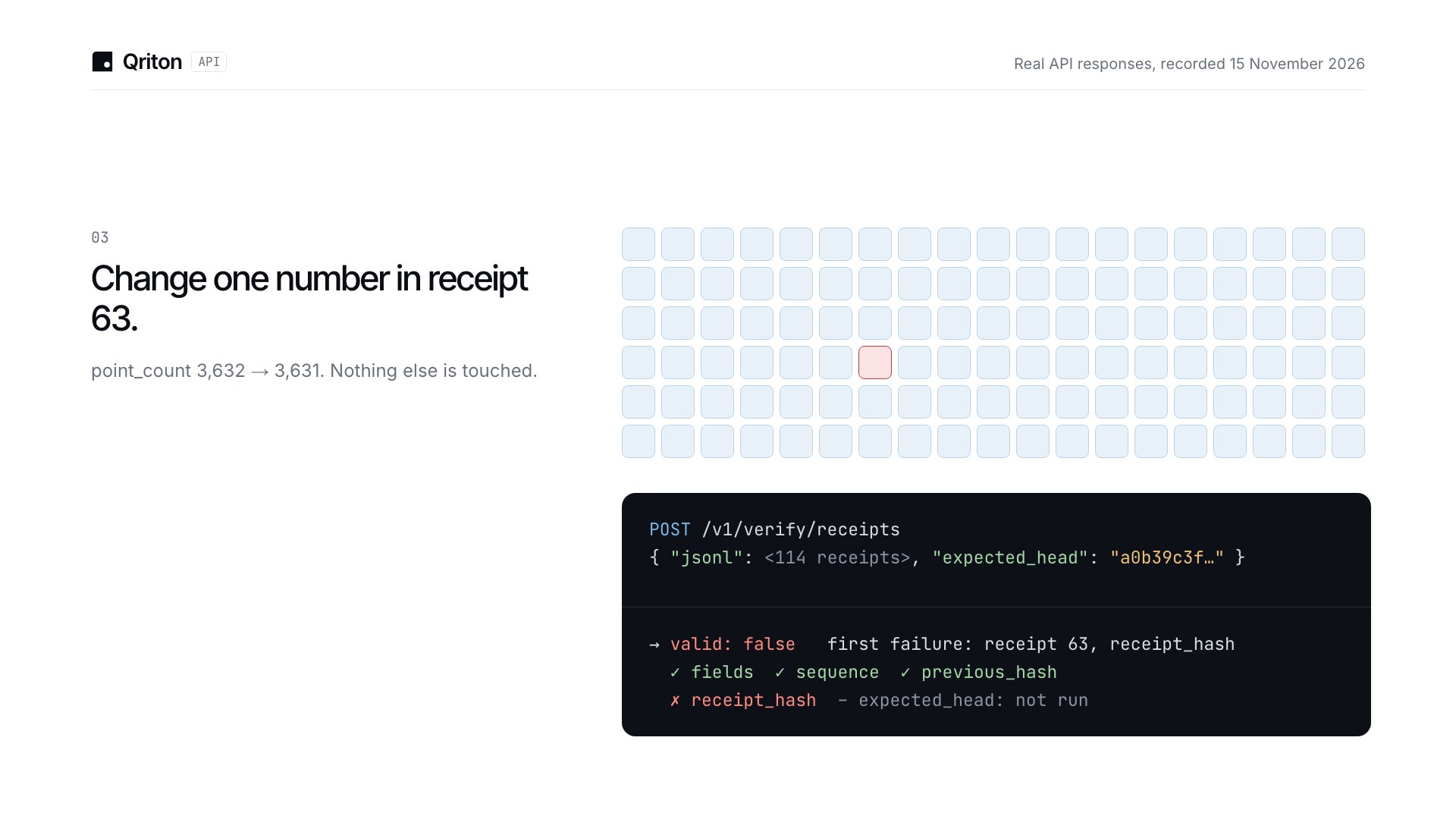 Verification APICheck that a record of changes is complete and unaltered.
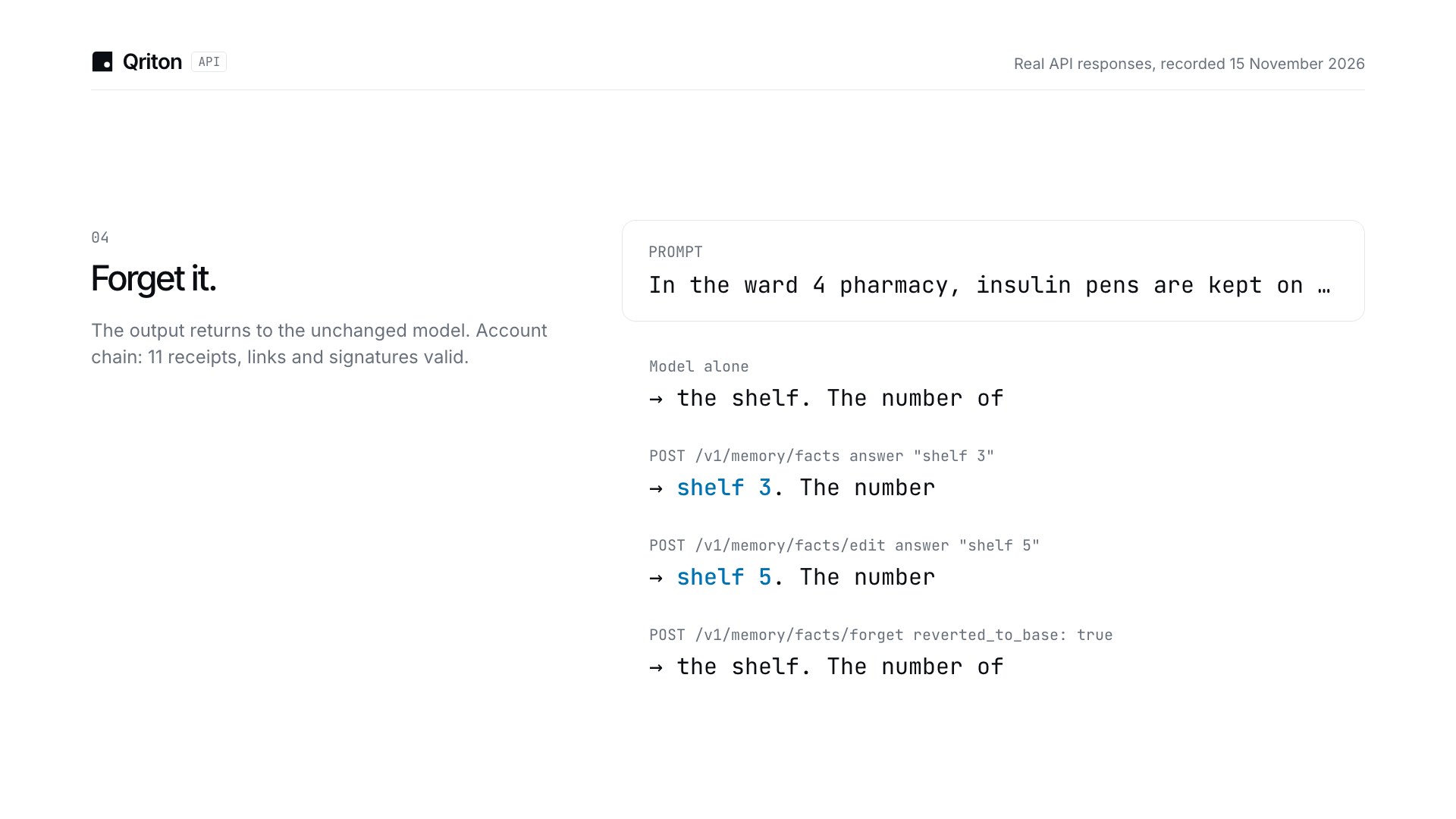 Memory APICorrect what a language model says, without retraining it.
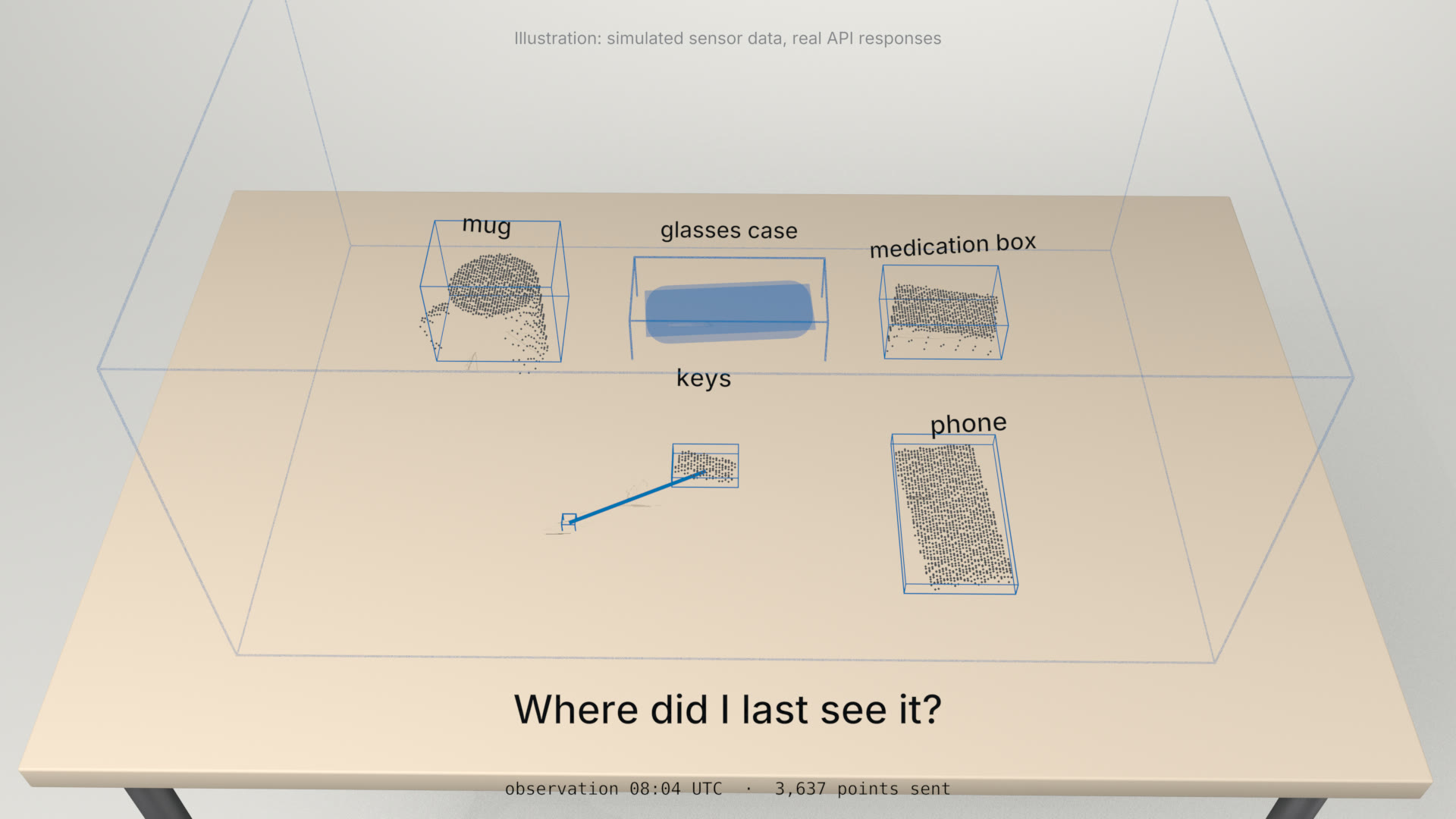 Spatial Memory APIWhere did I last see it? Answered from 3D points, without an image.
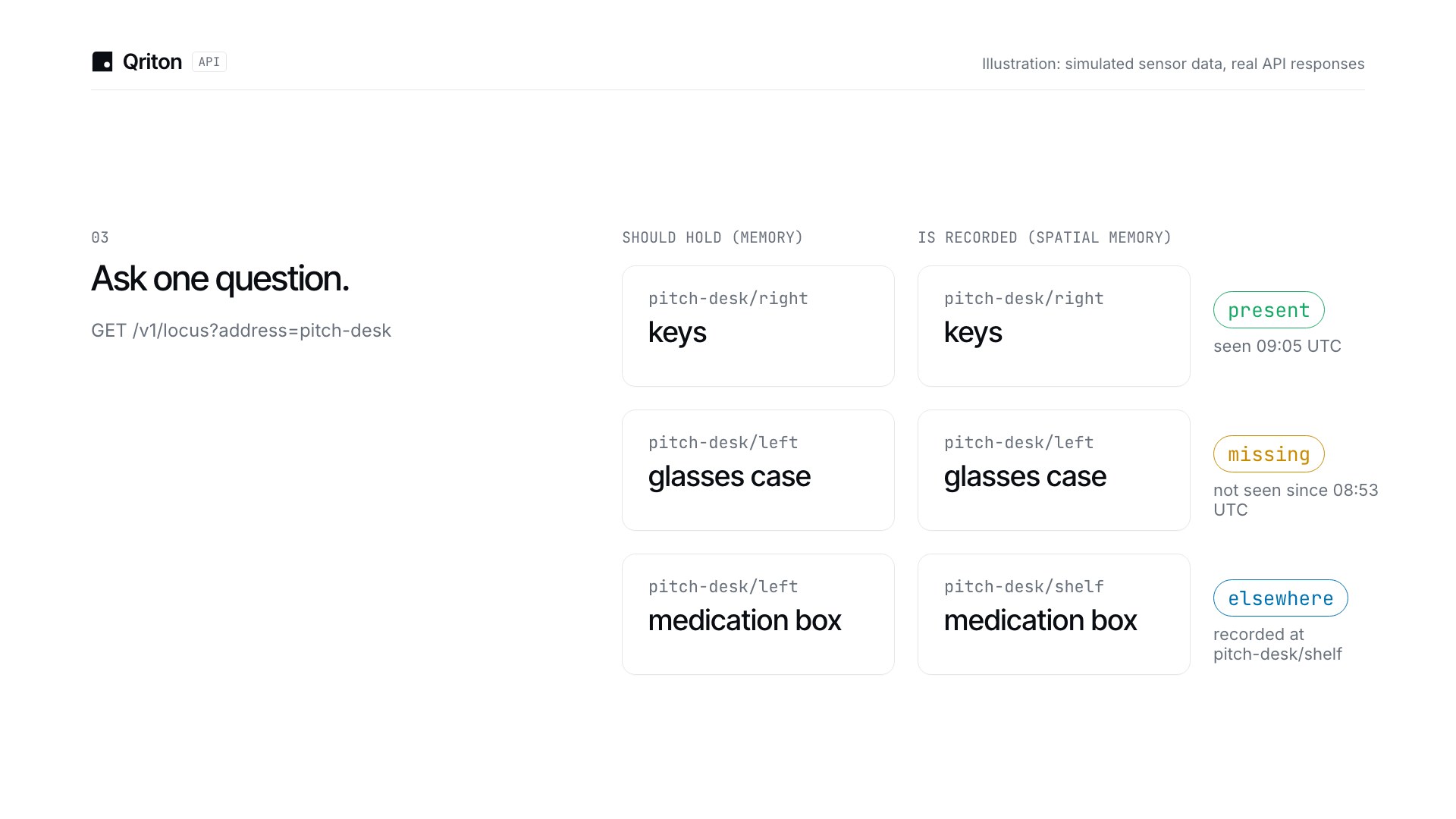 Locus APIOne address for what a place should hold and what is really there.
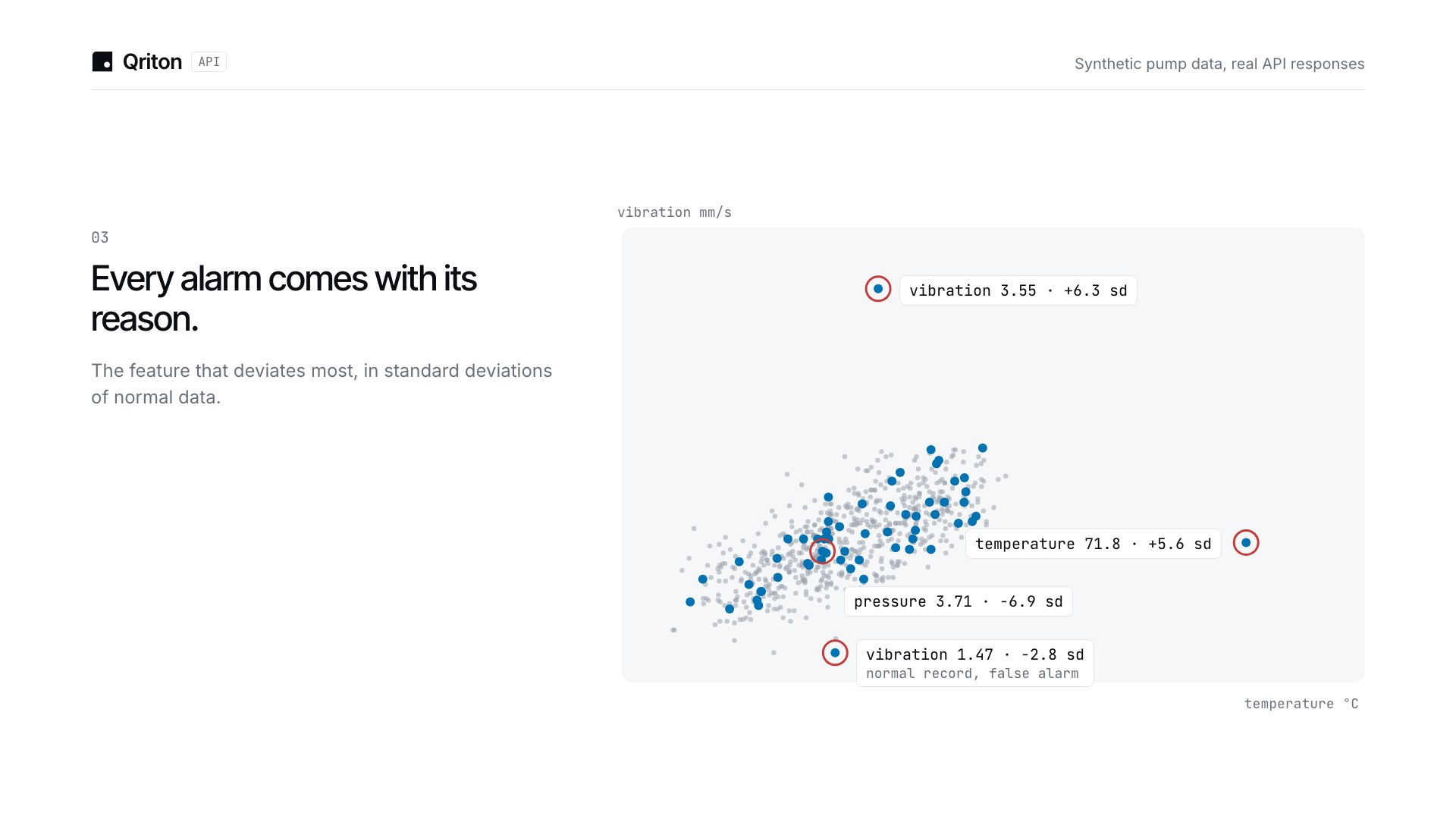 Anomaly APIFlag unusual records, and keep a record of every decision.
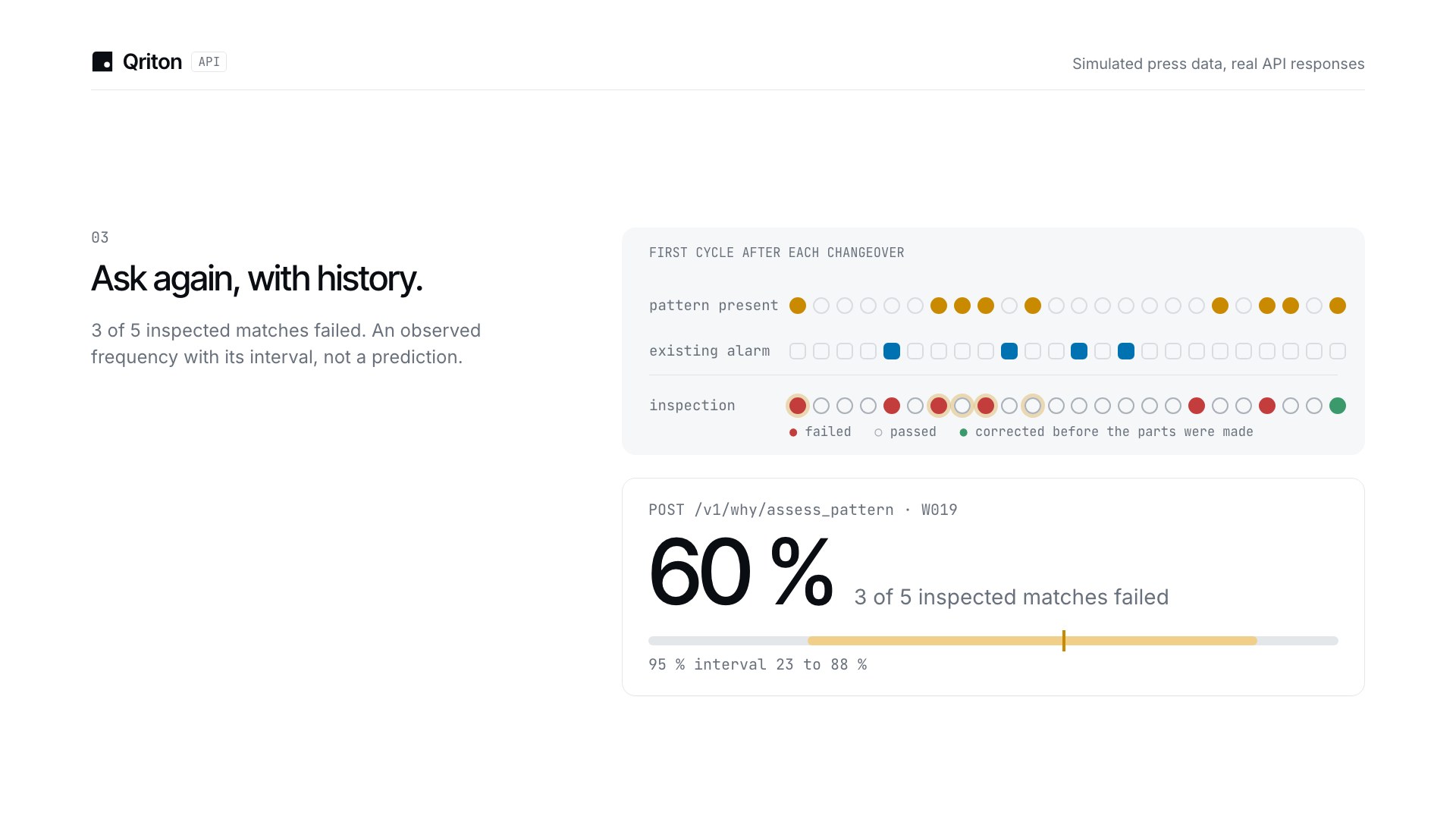 Why APICheck every warning against what happened next.
Signals APISee the evidence Qriton Signals produces before you commission monitoring.